


Radium, Tritium and Superluminova: the complete history of Lume in vintage watches

In vintage watch collecting, few details generate as much fascination — and as many questions — as the luminous material applied to dials and hands. Collectors call it simply "lume." And while that small deposit of glowing compound may seem like a minor detail, it is in reality one of the most historically rich, technically complex, and value-determining elements of any vintage timepiece.
This guide covers the full arc of lume history in wristwatches: from the era of radium-painted dials at the turn of the twentieth century, through the long age of tritium, to the contemporary Superluminova compounds used today. Understanding these materials is not merely a matter of curiosity — it is essential knowledge for any serious collector.
Why lume matters to collectors
The luminous material on a vintage watch is, in many ways, a silent certificate of authenticity. Because lume ages in chemically specific ways that are extremely difficult to replicate, a dial's lume can confirm or cast doubt on the age and originality of a timepiece in a way that few other elements can.
When a dial and its hands display matching lume — the same tone, the same degree of patination, the same aging pattern — this is a strong signal of originality. Conversely, mismatched lume between hands and dial, or lume that appears artificially applied or too uniform in color, is one of the most reliable indicators of a replacement part or a falsified watch.
Beyond authentication, the aesthetic quality of aged lume has become a driver of value in its own right. Certain colors, aging patterns, and textures of patinated lume are actively sought by collectors as marks of character and history. The so-called "tropical" effect — which in some cases involves not just the dial lacquer but also the lume compound — can multiply the market value of an otherwise standard reference.
The Radium Era: beauty and danger (1910s–1960s)
The story of luminous watches begins with radium. Discovered by Marie and Pierre Curie in 1898, radium-226 is a naturally occurring radioactive element that emits a continuous greenish glow when mixed with zinc sulfide — a phosphorescent compound that converts the energy of radioactive decay into visible light.
The watchmaking industry adopted radium paint enthusiastically from around 1910 onward. For the first time, it was possible to read a wristwatch in total darkness without any external light source. The material was applied by hand — by young women workers known in history as the "Radium Girls" — to the indices, hands, and sometimes even the inner bezels of military and civilian watches alike.
The story of the Radium Girls is one of the darkest chapters in industrial history. Employed at facilities such as the United States Radium Corporation in New Jersey, these workers were instructed to point their brushes with their lips, unknowingly ingesting radioactive material with every stroke. The resulting health consequences — jaw necrosis, bone cancer, and early death — came to light only after years of corporate suppression. The ensuing legal battles and public outcry became a landmark moment in the history of workers' rights and industrial safety regulation.
From a purely collecting standpoint, radium dials are identified today by their characteristic cream, ivory, or warm yellow patina. The zinc sulfide compound long exhausted its phosphorescent charge — radium dials no longer glow in the dark — but the decay products of radium leave a distinctive discoloration that is unmistakable to the trained eye.
From a safety perspective, intact radium dials present minimal risk when the watch is simply worn on the wrist or stored in a case. The radioactive material becomes dangerous only when the paint is flaking, crumbling, or being handled without protection. Collectors who own radium-dial pieces should avoid disturbing the surface and exercise caution when opening the caseback. Watchmakers working on radium-era pieces use specialized protocols.
Radium continued to be used in watchmaking well into the 1950s and even into the early 1960s, particularly for military and dive watches, though regulatory pressure accelerated its replacement with safer alternatives.
Identifying radium Lume
Characteristic cream to deep ivory patina. Possible presence of small dark spots or uneven coloration from decay products. No phosphorescence when charged with light. On military watches from the 1940s and 1950s, casebacks sometimes carry engraved or stamped radiation warnings relating to the radium content — as can be observed on exceptionally rare pieces like the Tornek-Rayville TR-900 U.S. Navy dive watch.
The Tritium Era: safety, stability, and the beloved patina (1960s–1998)
By the late 1950s and through the 1960s, the watchmaking industry progressively shifted from radium to tritium — a radioactive isotope of hydrogen. Tritium-3 is a beta emitter, meaning it releases low-energy electrons rather than the more penetrating alpha and gamma radiation of radium. This made tritium vastly safer both for the workers applying it and for the wearers.
Tritium was typically mixed with zinc sulfide or, later, with more efficient phosphorescent compounds, and applied in the same manner as radium paint — by hand on indices, hands, and bezels. Unlike radium, tritium-painted dials retain their phosphorescent capacity for years, though the radioactive decay of tritium (with a half-life of approximately 12.3 years) means that older tritium watches glow progressively less brightly over time.
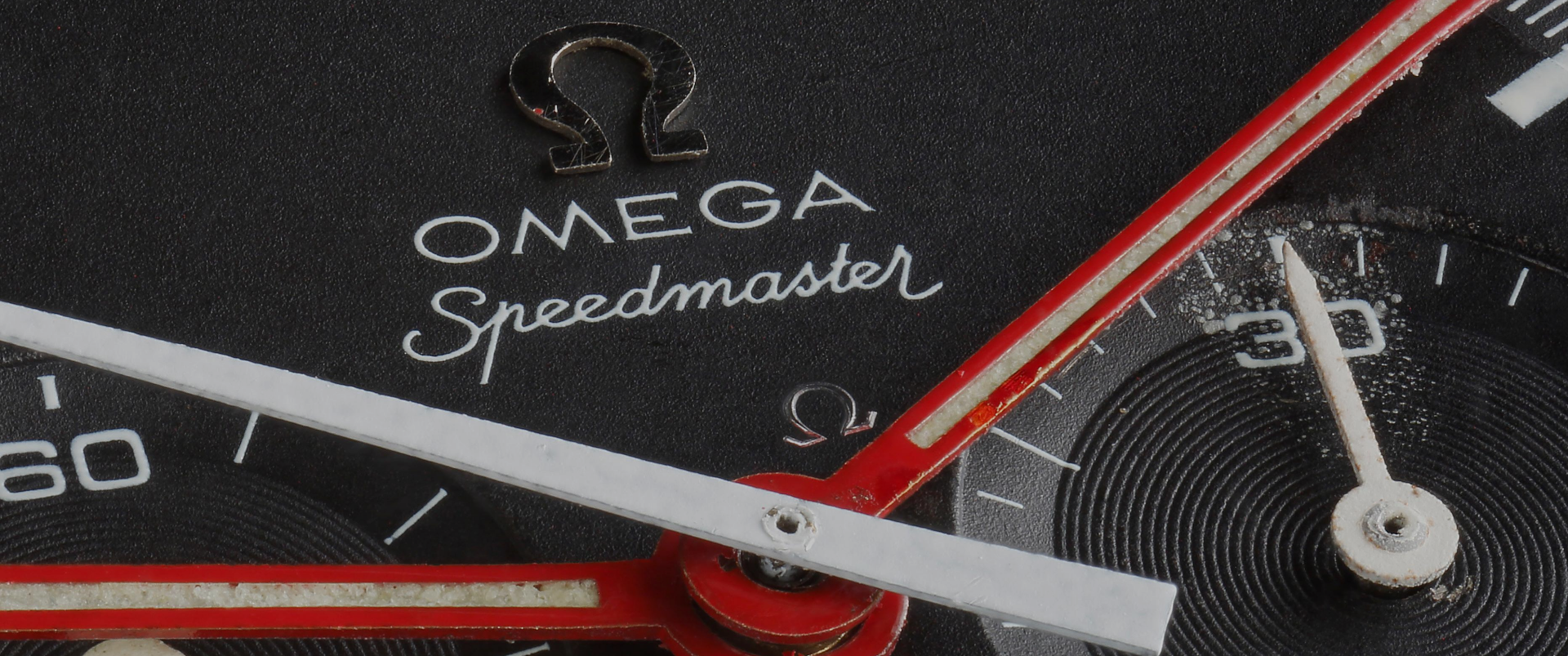
For collectors, tritium lume is most prized not for its glow — which on vintage pieces is largely spent — but for its aging properties. Over decades, the tritium compound develops a range of beautiful patina tones, from warm cream and soft beige to rich caramel, amber, and in some exceptional cases a deep chocolate brown. This aging is the result of the oxidation and degradation of the zinc sulfide compound and the binders used in the paint.
The range and quality of tritium patina has become one of the most discussed topics among advanced collectors. A Speedmaster with rich, evenly patinated lume matching perfectly between the hands and the dial is a fundamentally different object from the same reference with replaced hands and fresh lume. The former carries the authentic marks of time; the latter has lost part of its identity.
The early Omega Speedmaster references are among the most celebrated examples of tritium lume collecting. The Speedmaster ref. 2915-1, produced around 1958 and representing the very first generation of what would become the NASA Moonwatch, features broad arrow hands and dial indices with tritium lume that has aged over sixty-five years into a spectrum of warm, caramel tones that no reproduction can replicate. The lume on such a piece is not merely a detail — it is one of the primary markers of originality and age.
Regulatory requirements imposed in the 1990s eventually phased out tritium. Swiss watchmakers were required to mark tritium dials with the letter "T" followed by the level of tritium activity in millicuries or microcuries. This notation — commonly "T Swiss Made T" on the dial perimeter — is now a distinctive marker of period tritium production.
Reading the T Marking
"T Swiss Made T" or "T < 25" appearing on the dial perimeter indicates a tritium-lume dial produced under Swiss regulatory compliance. The T markings were introduced progressively from the late 1960s and became standardized through the 1970s and 1980s. Earlier dials (and particularly pre-regulation military pieces) may carry no marking even though tritium was the luminous material used.
Superluminova and the modern age (1998–present)
The successor to tritium in mainstream watchmaking was not a radioactive compound at all. Superluminova, developed by the Swiss company RC Tritec AG and introduced commercially in the late 1990s, is a non-radioactive photoluminescent material — it absorbs visible light and re-emits it over time, producing a glow without any radioactive process.
Superluminova offered the watchmaking industry a material that glowed brightly, was entirely safe, and required no special regulatory compliance. It was adopted rapidly across the industry from 1998 onward, effectively ending the use of radioactive luminous compounds in commercial watchmaking.
From a collecting perspective, Superluminova dials are simply too recent to have developed meaningful patina. They are bright, uniform in color (typically in shades of white, green, or blue depending on the specific compound grade), and do not age in the visually compelling way that radium and tritium materials do. For collectors focused on the pre-quartz and early quartz era, Superluminova is therefore primarily relevant as a boundary marker — the presence of Superluminova on a movement or dial intended to be from the 1960s or 1970s is an immediate red flag.
Lume as authentication tool
For serious collectors and professional dealers, lume analysis is a frontline authentication tool. The following principles guide evaluation:
Consistency: on an original, unrestored watch, the lume on hands and dial should display the same aging pattern, tonality, and degree of degradation. Mismatches suggest that either the hands or the dial have been replaced.
Period-correct compound: the type of lume should correspond to the known production date of the reference. A 1958 Speedmaster should have radium or early tritium. A 1975 Submariner should have tritium. The presence of Superluminova on a 1960s reference indicates either replacement hands, a later-service application, or a fake.
Surface integrity: original lume, even when extensively patinated, typically retains a consistent surface profile. Fresh applications, relumed indices, or touched-up patches often show irregularities in texture, edge definition, or adhesion that are visible under magnification.
Color uniformity: on an original dial, the aging of lume tends to be relatively uniform across all indices and across both hands, since all elements were produced at approximately the same time and have been subject to the same environmental history. Outliers — a single index that is darker, lighter, or differently textured than the rest — are worth investigating.
The collector's perspective: how to approach Lume
The most important rule for collectors approaching vintage watches with significant lume is: do not restore. Original patinated lume, even if discolored, crumbling at the edges, or partially lost, is immeasurably more valuable than relumined indices. A professional restoration may improve the cosmetic appearance of a dial but it destroys the primary material evidence of the watch's authentic history.
This principle is now well-established among advanced collectors and professional dealers of the caliber of Andrea Foffi. Pieces presented with full transparency about their lume — its age, its type, its condition — are valued precisely for what they are: authentic records of time.
When evaluating a purchase, ask for clear, high-resolution photographs of the dial and hands under both direct light and in the dark (using a long-exposure photograph after charging with a flashlight, in the case of tritium pieces that retain some activity). Compare the lume tone on the hands against the dial. Ask the seller about any known service history. And when in doubt, trust the expertise of a specialist.
Conclusion
The luminous material on a vintage watch dial is far more than a functional detail. It is a chemical record of the watch's era, a visual token of its authenticity, and in the finest examples, a source of extraordinary aesthetic beauty. From the dangerous glamour of radium-painted dials to the warm amber patina of aged tritium on a 1950s Speedmaster or a Tornek-Rayville military dive watch, lume tells the story of decades in a language that only those who know how to read it can fully appreciate.
Understanding lume is not optional for the serious vintage watch collector — it is fundamental. And like all deep knowledge in this field, it is best developed in the company of extraordinary examples.
