


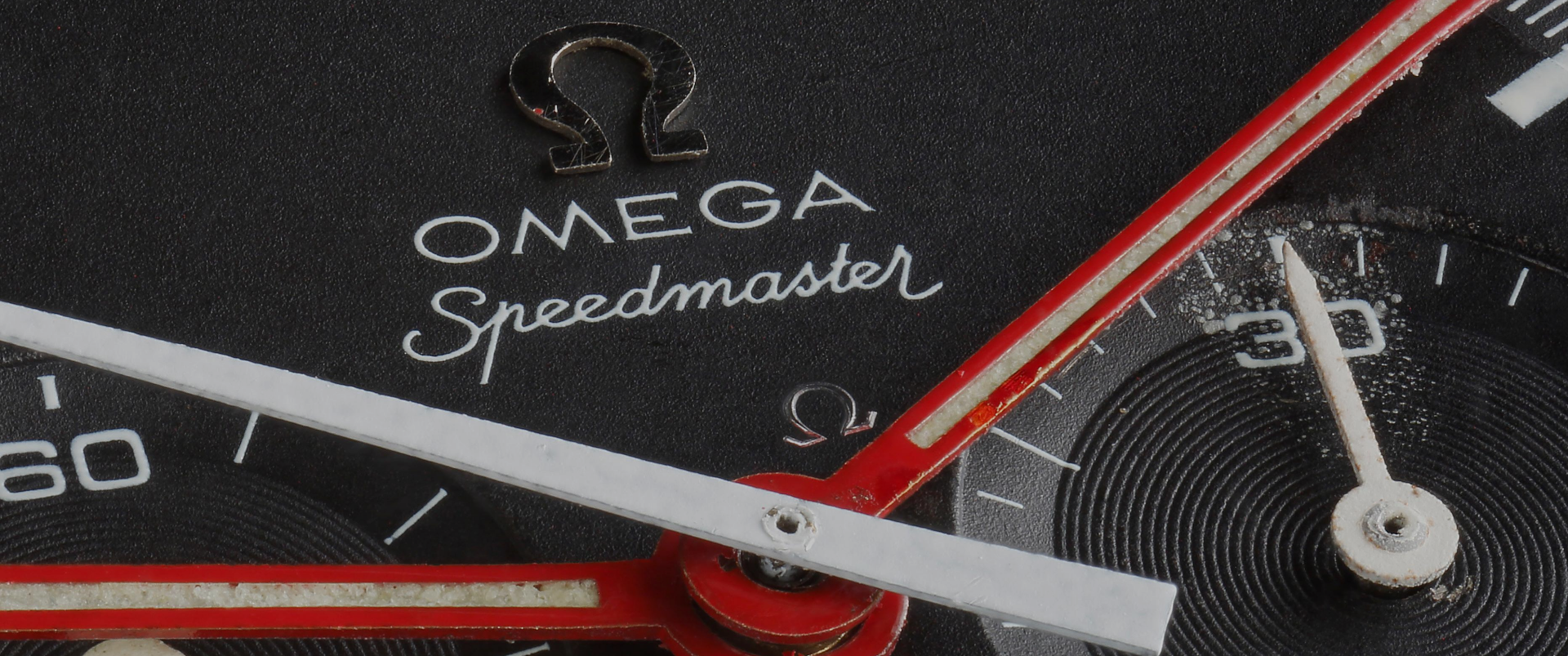
Omega Speedmaster Pre-Moon: the complete reference guide from CK2915 to 105.012

Mention the Omega Speedmaster, and thoughts almost automatically jump to 1969 and Buzz Aldrin's wrist on the Moon. But the story that made that moment possible begins twelve years earlier, with a series of references now collectively known as "pre-Moon": the Speedmasters produced before NASA effectively made them the protagonists of history's most celebrated space mission.
These are the references collectors chase hardest, not only for their connection to space, but because they all share the same mechanical heart: the Caliber 321, today regarded as one of the finest manual chronograph movements ever made.
The Caliber 321: the Heart of the Pre-Moon Speedmasters
The Caliber 321 was born in 1942 from a joint venture between Omega and Lemania, at the time a subsidiary of the Omega group. Its mechanical base is a Lemania ébauche, the caliber 2310: a column-wheel, lateral-clutch chronograph movement, considered among the finest of its era. The same principle, the same concept of an ébauche we explored in our guide on in-house or ébauche movement, here applied to one of the most celebrated calibers in watchmaking history.
The Lemania 2310 base didn't remain an Omega exclusive: the same architecture, in its own variants, was also adopted by Patek Philippe, Vacheron Constantin, and Breguet for some of their high-end chronographs. A detail that says a great deal about how solid that mechanical foundation was considered, well beyond the sports segment where Omega would make it famous.
CK2915 "Broad Arrow" (1957-1959): the First Speedmaster
It all begins in 1957, with the CK2915, launched alongside the Seamaster 300 and Railmaster as part of Omega's "Professional" collection. The "Broad Arrow" nickname comes from the shape of the hour hand, shared with other professional models of the same period.
The CK2915 is distinguished by a metal tachymeter bezel with engraved markings, a black "step dial" — named for the recessed rim around its three sub-registers — a 38.5mm case with straight lugs, and radium lume on hands and indexes. It was produced in three variants (-1, -2, -3) and, based on collectors' estimates drawn from cross-referencing, in relatively limited numbers, which makes it one of the rarest and most sought-after Speedmasters today: in 2018, a CK2915-1 example set an auction record for the model at Phillips, a record later surpassed by another example of the same reference.
CK2998 (1959-1962): the transition
The CK2998 retains the CK2915's overall approach, still powered by the Caliber 321, but marks the start of a transition in hand design, moving from "broad arrow" to the alpha shape that would become standard on later references.
ST105.002 (1962): the new numbering system
In 1962, Omega introduced a new reference numbering system. The 105.002 kept the straight-lug case and black tachymeter bezel, with either alpha or broad-arrow hands depending on the example. It's also the last Speedmaster to use radium as its luminous material, before the switch to tritium on later references — a detail that connects this reference directly to our guide on radium, tritium, and Super-LumiNova.
ST105.003: the last of the straight-lug cases
The 105.003 closes out the straight-lug generation of Speedmasters, often described by collectors as "pre-professional." It carries white baton hands and is the reference that passed NASA's spaceflight qualification testing. It's also the watch worn by Ed White during the first American spacewalk, in 1965.
ST105.012 (from 1964): the Birth of the "Professional"
The 105.012, introduced in 1964, is the first Speedmaster to officially carry the "Professional" designation on its dial, and represents the most significant aesthetic shift in the pre-Moon family. The case grew to 42mm with an asymmetrical design, built to shield the crown and pushers, and the lugs became faceted, in the shape now known as "lyre lugs." An internal rubber membrane also improved water resistance around the pushers.
It still ran the Caliber 321, and is the reference — alongside the contemporaneous 145.012 — worn by astronauts during the Gemini and Apollo missions. It's the Speedmaster on Buzz Aldrin's wrist during the historic Moon walk of July 20, 1969: Neil Armstrong, by contrast, left his own aboard the lunar module as a backup, after the onboard timer failed.
1968: the end of the pre-moon era
In 1968, with the introduction of reference 145.022, Omega replaced the Caliber 321 with the Caliber 861: an evolution designed to simplify production, replacing the column wheel with a switching cam while retaining the lateral clutch. A more pragmatic, cost-conscious choice, which conventionally marks the end of the pre-Moon era and the beginning of the long history of the Speedmaster Professional as we know it today.
Why pre-Moon references command a premium
Three main factors explain where pre-Moon references sit in the collector market:
- Relative rarity, especially for the CK2915, produced in limited numbers compared to later Speedmasters
- The mechanical prestige of the Caliber 321, column-wheel controlled, generally regarded as more refined and complex to produce than the cam-operated Caliber 861 that replaced it
- A direct historical link to the American space program, a source of appeal that extends well beyond watch collecting in the strict sense
What to Check Before Buying a Pre-Moon
As with any significant vintage purchase, consistency across components is the decisive factor. On a pre-Moon Speedmaster in particular, it's worth checking:
- Consistency between dial, case, and caliber, following the general approach we cover in our guide on how to spot a fake vintage watch
- Dial originality, as with any vintage chronograph of this caliber, covered in depth in our guide on original vs redone dials
- The crown, often replaced over the decades: our guide on the vintage watch crown explains what to look for
- Archival documentation, where available, to confirm consistency between serial number, reference, and stated caliber
A Dealer's perspective
Pre-Moon Speedmasters are among the most fascinating pieces to evaluate, precisely because of how layered their history is: seven years of small evolutions, three transitional references, a single caliber. It's territory where precise knowledge of the differences between references is what separates a confident purchase from a costly mistake — exactly as it is with any other iconic vintage chronograph at this level.
