


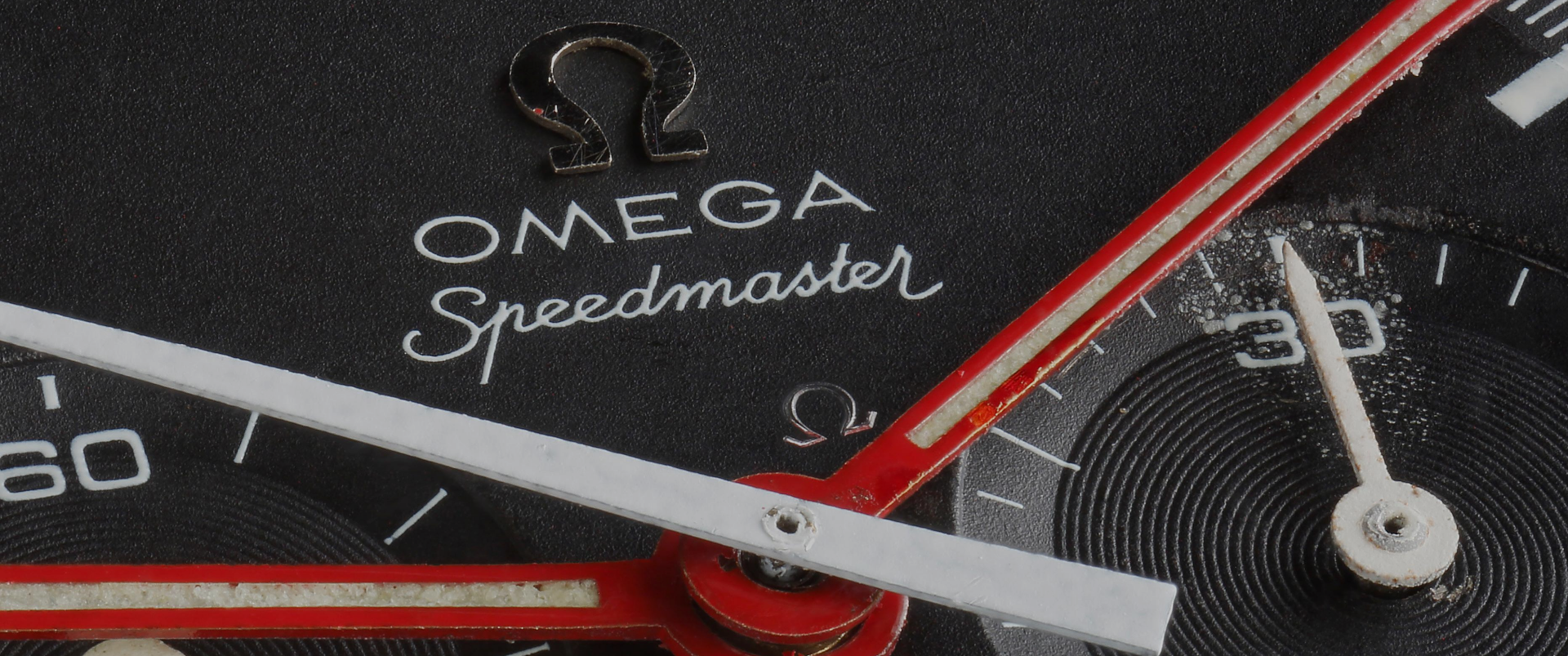
Sigma Dial: the small symbol that certifies gold (and exposes refinished dials)

In vintage collecting, the smallest signs are almost always the ones that carry the most weight. An experienced collector does not simply look at a watch — he reads it. And among all the lines of that silent text, there is one that countless enthusiasts have in plain sight yet cannot decode: two tiny Greek letters printed on either side of the word "SWISS," just below six o'clock. It is the symbol σ, the sigma. It is not a graphic flourish, nor a maker's mark. It is a certification, a date and, very often, a tool for authentication. Learning to recognise it means owning a key that separates the distracted eye from the expert one.
What the σ symbol actually means
The sigma on a dial certifies one precise thing: that the hour markers — and very often the hands as well — are made of solid gold, typically 18 karat. Not gold plating, not gilded metal: real gold, applied by hand.
The configuration is always the same. On either side of the text at the foot of the dial sits a pair of sigmas: σ T SWISS T σ. It is worth unpacking the rest of the formula too, because it causes confusion. The two "T" letters flanking "SWISS" indicate the use of tritium as the luminescent material — a subject we explored in our history of lume in vintage watches. The two sigmas, on the other hand, speak exclusively of gold. Two different pieces of information, compressed into a few millimetres of print.
1970: gold as an answer to the quartz crisis
To understand why that symbol exists, we must return to the most dramatic moment in the history of Swiss watchmaking. In the early 1970s, Japanese quartz was eating into market share, accuracy was no longer a selling point, and the entire mechanical industry was desperately searching for a way to justify the price of a winding watch. At the same time, the price of gold was climbing steeply.
The answer came from a consortium of manufactures gathered under the acronym APRIOR — Association pour la Promotion Industrielle de l'Or, the Association for the Industrial Promotion of Gold. The idea was as simple as it was clever: if precision could no longer be sold, substance could. Declaring the presence of gold on the dial in a visible, verifiable way was a way of reminding the buyer that this object — unlike a cheap quartz watch — possessed intrinsic value. The symbol chosen was the Greek letter sigma. The mark was filed in August 1971 and registered in July 1972, with documented first use as early as 25 February 1970. From then on, throughout the decade, the sigma became the discreet signature of a watchmaking tradition determined to reassert its nobility.
Not only yellow gold: the paradox of steel
Here lies one of the aspects that surprises those approaching the subject for the first time. The σ symbol is very frequently found on watches in steel. How is that possible, if it certifies gold?
The explanation is elegant. On a steel case, applied markers in 18k white gold are chromatically almost indistinguishable from the steel itself. Without a declaration, the buyer would have no way of knowing that those reflections come from a precious metal rather than simply polished steel. The sigma existed precisely for this: to make visible a value that would otherwise remain invisible. This is why so many steel Rolex Datejust and Oyster Perpetual models from the 1970s carry the sigma — not for show, but out of communicative necessity. On yellow-gold or two-tone models the symbol still appears, but its "revealing" role is more subtle.
The real usefulness for collectors: dating and authenticating
If the sigma were merely a period detail, it would be a curiosity. It is far more than that: it is one of the most reliable — and most underrated — authentication tools available to anyone buying vintage.
The reasoning is purely logical and rests on dates. The sigma belongs to a precise window: it emerged around 1970 and accompanied Swiss production fitted with gold markers or gold plates throughout the decade, then gradually faded in later periods depending on the maison. This placement turns it into an immediate consistency test:
-
A watch produced before 1970 wearing a sigma dial is almost certainly displaying a service dial — a replacement fitted during a later intervention, not the original dial. A piece from 1958 could not have been born with a symbol introduced twelve years later.
-
By the same logic, a sigma dial on an example clearly produced after the end of the APRIOR era deserves the same scepticism.
For a serious collector this is a difference that can be worth thousands: as we explain in our feature on why the dial is the soul of a watch, an original dial consistent with the production date is one of the factors that most affect value. Read with the mind and not just the eye, the sigma is a valuable ally when it comes to recognising a fake or tampered vintage watch too.
Where to find it: the maisons that adopted the sigma
The sigma was no niche phenomenon: it was adopted by some of the most prestigious houses on the planet. Among the best-known members and users are Rolex, Patek Philippe, Vacheron Constantin and IWC, but the symbol also appears on Omega — where, incidentally, the Biel house sometimes also used the "OM" abbreviation to signal solid-gold markers — and on other high-end Swiss brands such as Longines.
At Rolex the sigma turns up on specific references: the Datejust 1601 and 1603, the Day-Date 1803, the various Date and Oyster Perpetual models, the dressy Cellini and — a detail that makes purists' hearts race — some hand-wound Cosmograph Daytona references such as the 6263 and 6265. You will not find it, however, on Submariner, Sea-Dweller or Explorer models of the same era: those watches had no gold surrounds around the luminous markers, and therefore had nothing to certify. On Patek Philippe and Vacheron Constantin, by contrast, the sigma accompanies the dials of time-only and complicated watches across a longer span, which makes reading it even more interesting — and dating even more useful.
Sigma and value: why those two marks matter
There is a market reason why a collector lights up in front of an authentic sigma. Because the symbol was used for a limited number of years, dials that carry it are relatively scarce compared with a reference's total production. On otherwise common models, that small σ can make the difference between an ordinary example and a sought-after one. The most celebrated case is the hand-wound Daytona with a sigma dial, which is invariably rewarded with a premium whenever it surfaces at auction.
But the value here is not only financial. It is the value of consistency. A watch whose dial accurately tells its own era — tritium, gold, correct printing — is an object that has preserved its own truth. And truth, in vintage, is the rarest commodity of all.
Reading the margins
The mature collector is not seduced by the grand gesture — the bezel, the name on the dial, the famous reference. He concentrates on the margins, literally: on the millimetres at the foot of the dial, where two Greek letters reveal what metal time is made of and in what year it was built. The sigma is all of this. A minuscule symbol, born of a crisis, that became over the years one of the most elegant — and most revealing — signatures of twentieth-century watchmaking.
If you own a vintage watch and want to understand whether its dial is consistent, original and correctly valued, our appraisal service is the right place to start reading it together, margin by margin.
